
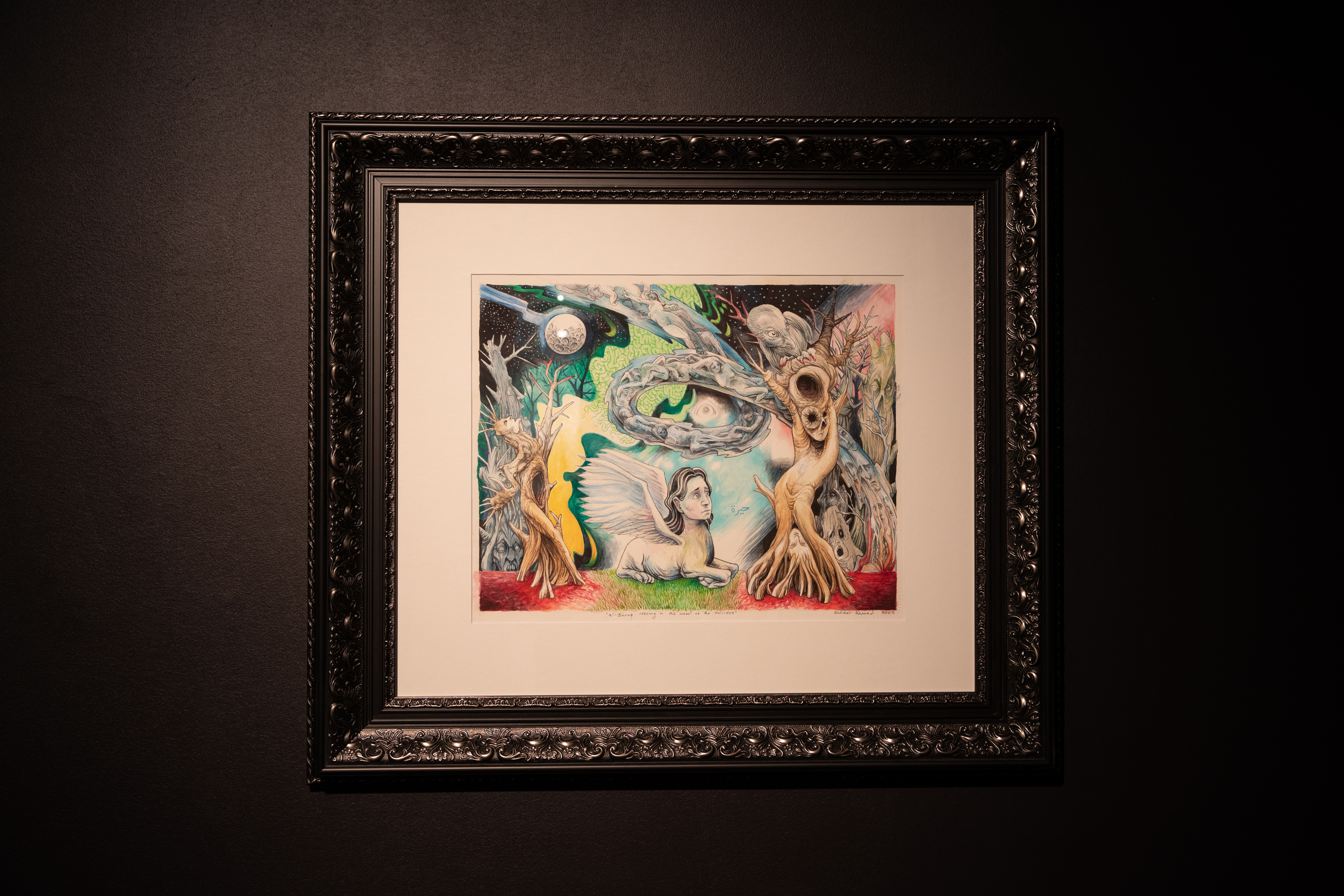
Title: ‘al-Buraq resting in the wood of the suicides’, 2023, Medium: Pen and ink, watercolour, texter and white medium on paper. Size: 53.5 x 42.5 cm
‘al-Buraq resting in the wood of the suicides’ combines my interest in the artist William Blake with contemporary comic art and the metaphysical preoccupations of Islamic mysticism. My picture depicts a scene from Dante’s Divine Comedy, inspired by Blake’s quixotic interpretation of the poem, into which is situated al-Buraq, the mythical, winged horse-like creature which Muslims believe transported the Prophet Muhammad from earth to heaven.
This choice of imagery plays to a historical speculation: that the European reception of the miraj (describing the Prophet’s ‘night journey’ to heaven) inspired the form of Dante’s Divine Comedy. The claim preempts arguments regarding the extent of Islamic cultural influence on medieval Europe, pursued by such historians as George Makdisi, María Rosa Menocal and Dmitri Gutas. Their research on cultural transmission, from the Muslim world to Europe, serves to critically undermine insular and exclusionary constructions of ‘The West’ – its history and identity.
My work joins a fascination for Blake’s imagery with an appreciation of 20th century comic book and fantasy art, including the works of Virgil Finlay and Jack Kirby. I would argue for the parallels between Blake’s visual experimentation and the sequential art of comics, in which iconographic text and imagery is arranged in a complimentary, sometimes dialogical fashion.
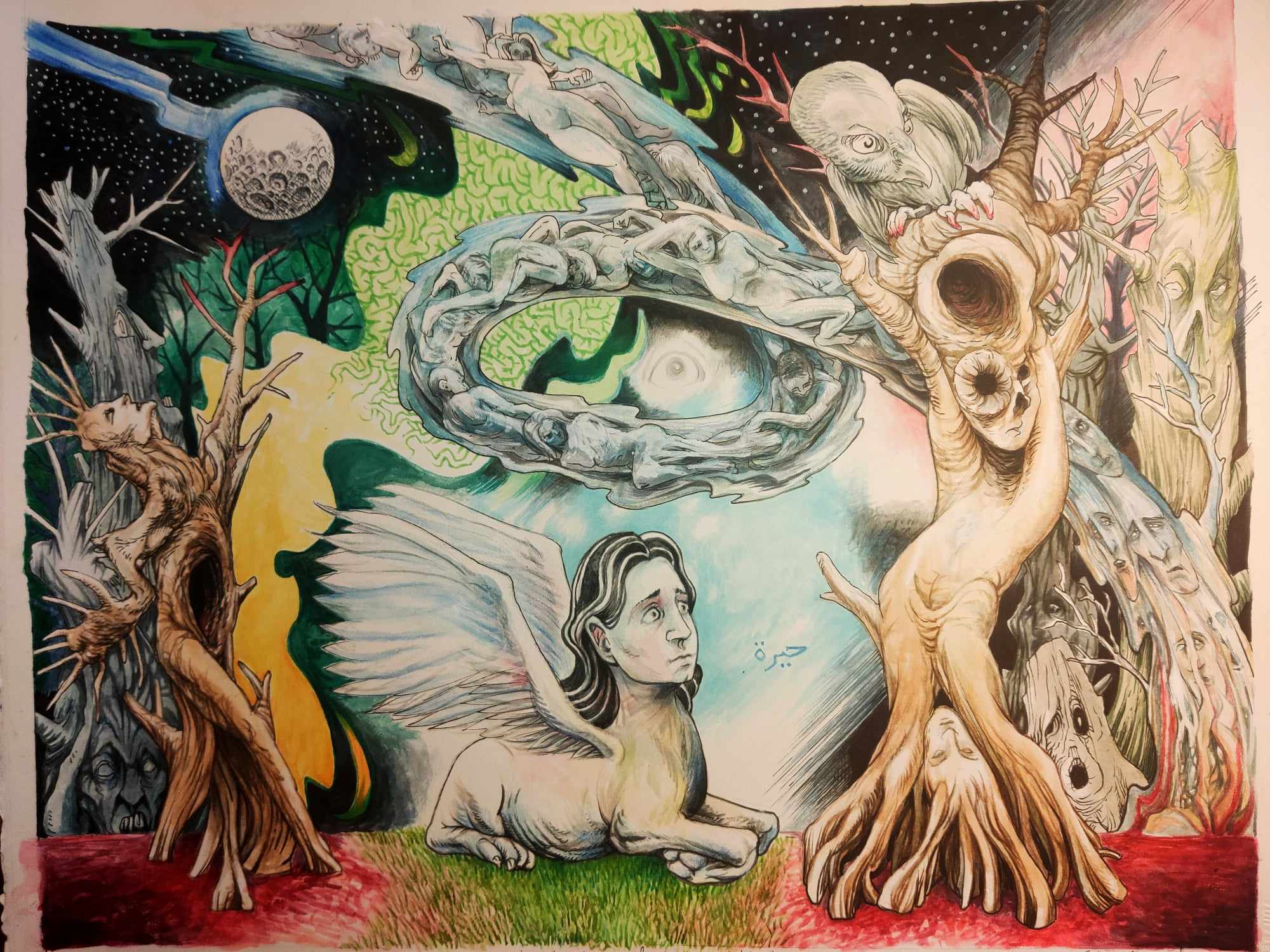
Images of the work in progress.
I often wonder about mainstream religious denunciations of suicide (for rejecting God’s creation) when reflecting on my own experiences of poor mental health. I loosely associate depression with the spiritual impasse Sufi metaphysicians called hayrah, described by Titus Burckhardt as: ‘dismay or perplexity… in the face of truths which cannot rationally be reconciled – a mental crisis, when the mind comes up against its own limit’.

My painting expresses a will to dissolve such intellectual and emotional dead-ends, and the binary conceptions they rest upon. This is achieved via the creative imagination (khayal) and its power to access a strange, otherworldly yet generous compassion.

 safdar ahmed